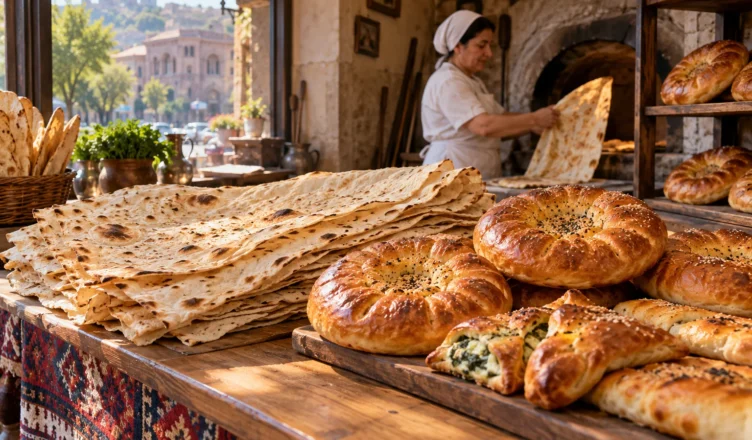
Some of the most memorable places in Yerevan are not museums, monuments, or famous restaurants.
They are bakeries.
Walk through almost any residential neighborhood in the morning and you may notice the smell before you see the shop. Warm dough, toasted crust, flour, butter, and sometimes something sweet drifting onto the pavement.
For travelers, stepping inside a local bakery can be one of the easiest ways to experience everyday Armenian life.
There is no ticket to buy, no guide to follow, and no complicated etiquette to learn. You simply walk in, look at what has just come out of the oven, choose something warm, and discover how seriously Armenians take bread.
This guide explains what you may find inside a Yerevan bakery, what different breads are like, how to order when you do not speak Armenian, and why a simple bakery visit can tell you surprisingly much about local culture.
Why Bread Matters So Much in Armenia
Bread is not treated as a minor side item in Armenia.
It often sits at the center of the table.
A meal may include meat, vegetables, cheese, herbs, soups, and sauces, but bread is usually present throughout. It is used for wrapping, sharing, dipping, and sometimes simply eating on its own while the rest of the food arrives.
For visitors from countries where bread is mostly sliced, packaged, and bought once every few days, the Armenian approach can feel different.
Freshness matters.
Many people prefer bread that was baked the same day, sometimes only minutes earlier.
That is why neighborhood bakeries remain part of everyday life even when supermarkets are nearby.
Start With Lavash — But Do Not Stop There
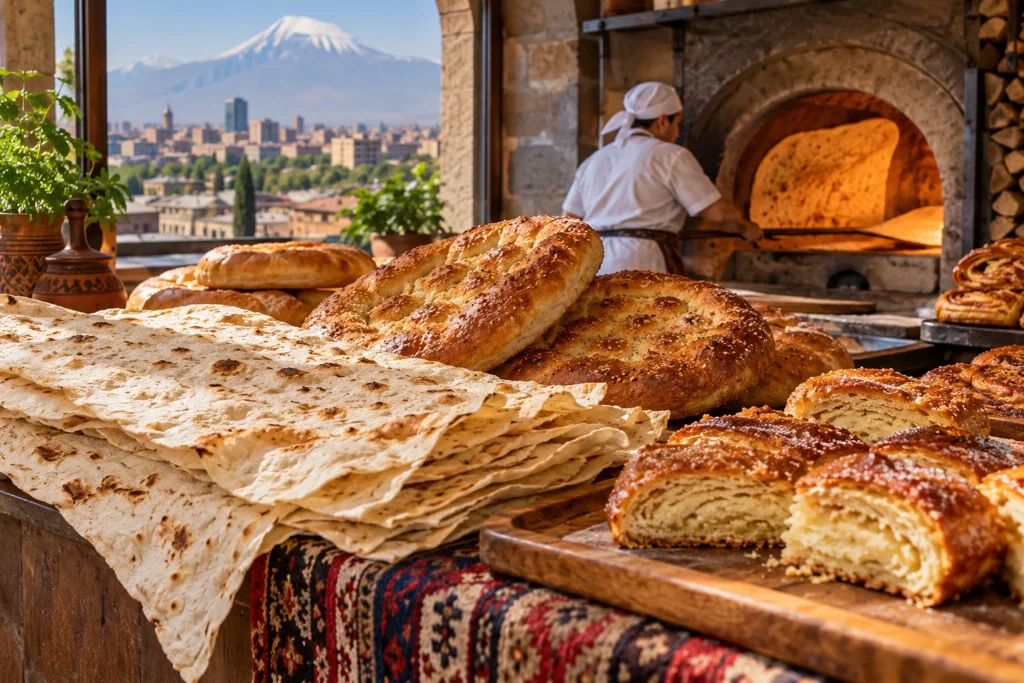
Most travelers already know the word lavash before arriving in Armenia.
Traditional Armenian lavash is thin, soft, flexible, and usually much larger than visitors expect.
It can be wrapped around cheese and herbs, served with grilled meat, used alongside soups, or simply torn into pieces and shared at the table.
In some bakeries, you may see stacks of fresh lavash folded carefully after baking.
The texture changes quickly as it cools, which is why freshly baked lavash feels very different from packaged versions sold abroad.
If you see it being prepared, watch for a moment.
The speed and precision can be fascinating.
Matnakash Is the Bread Many Visitors Discover Too Late
If lavash is Armenia’s most internationally recognized bread, matnakash may be the one travelers remember most after tasting it fresh.
Matnakash is thicker, softer, and more substantial.
It usually has a golden crust and an airy interior. Fresh from the oven, it can be slightly crisp outside while remaining soft and warm inside.
It works beautifully with cheese, butter, tomatoes, herbs, or simply nothing at all.
A piece of warm matnakash can turn a very simple breakfast into something memorable.
If you are staying in an apartment or guesthouse, buy one in the morning and take it back with local cheese, tomatoes, cucumbers, and fruit.
You do not need to cook anything.
Some Bakeries Are More Than Bread Shops
Do not assume every bakery sells only bread.
Depending on the neighborhood and the size of the shop, you may also find:
- gata;
- pastries filled with cheese or potatoes;
- small savory pies;
- sweet rolls;
- cookies;
- cakes;
- khachapuri-style pastries;
- seasonal baked goods.
Some places function almost like small takeaway cafés.
Locals may stop for breakfast on the way to work, buy something warm for children, or carry several loaves home for the family.
This makes bakeries interesting places for travelers who want to observe everyday routines rather than only tourist attractions.
Gata Can Mean Different Things
Visitors sometimes expect gata to be one single standardized pastry.
It is not.
Different bakeries and regions may prepare it differently.
Some versions are round and decorative.
Others are sliced.
Some are soft and bread-like, while others are more crumbly and rich.
The filling may include flour, butter, sugar, and other ingredients depending on the recipe.
If a bakery has several types, do not worry about choosing the “correct” one.
There is no need.
Buy a small piece of whichever looks freshest and try it with coffee or tea.
How to Order When You Do Not Speak Armenian
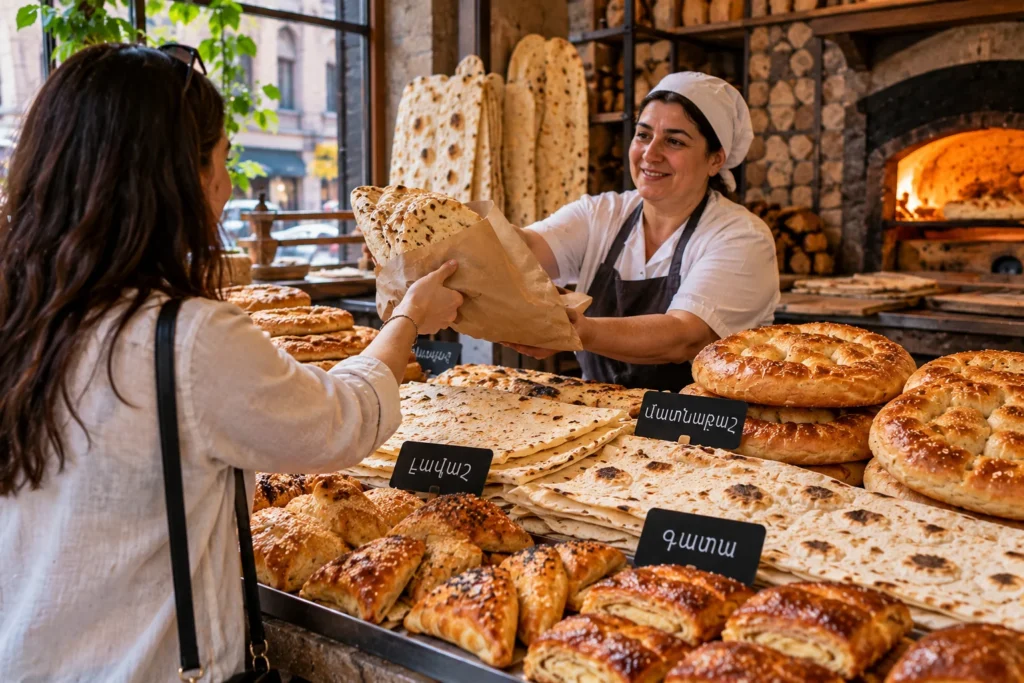
Ordering in a small bakery is usually easier than travelers imagine.
You do not need a long conversation.
Look at the display, point to what you want, and show the quantity with your fingers if necessary.
A few simple words can help:
“Lavash” — լավաշ
“Matnakash” — մատնաքաշ
“Gata” — գաթա
“Thank you” — շնորհակալություն
Do not worry about perfect pronunciation.
In busy bakeries, pointing and smiling are perfectly normal.
If prices are not clearly displayed, ask before paying or look at the register screen.
Cash or Card?
Payment options vary.
Many modern bakeries in central Yerevan accept cards, while very small neighborhood shops may prefer cash.
It is useful to carry some Armenian drams in smaller denominations.
This is especially helpful when buying only one piece of bread or a small pastry.
Payment practices can change, so if card payment is important to you, check before ordering several items.
The Best Time to Visit
Morning is often the most interesting time.
That is when bakeries are busiest, shelves are being refilled, and bread may still be warm.
Early evening can also be lively because people stop on the way home.
There is no universal schedule, however.
A neighborhood bakery may begin very early and close early, while another may operate late into the evening.
If you are walking through a residential area and see people entering with empty bags and leaving with warm bread, that is usually a good sign.
Follow the locals.
Do Not Be Afraid of Residential Neighborhoods
You do not need to stay near Republic Square or Cascade to find good bread.
In fact, some of the most interesting bakeries are located far from the main tourist streets.
Residential neighborhoods often have small shops serving the same families every day.
These places may have simple interiors, fewer English signs, and no social-media-friendly design.
That does not make them less interesting.
Sometimes the opposite is true.
A shop does not need to look fashionable to produce excellent bread.
Watch How Locals Buy
One of the easiest ways to understand a bakery is simply to observe for a minute.
Do people ask for one loaf or several?
Is bread wrapped or handed over directly?
Are people buying breakfast pastries?
Are families taking large amounts home?
These small details reveal how bread fits into everyday life.
You may notice that customers know exactly what time a particular bread comes out of the oven.
Some even wait a few minutes for a fresh batch rather than taking what is already on the shelf.
Warm Bread Changes the Experience
There is something important travelers often miss.
Armenian bread tastes different when it is truly fresh.
A packaged lavash from a supermarket can be useful and perfectly good.
But eating bread only minutes after baking is another experience entirely.
The aroma is stronger.
The texture is softer.
Even simple ingredients suddenly taste better beside it.
This is why a bakery visit should not be treated only as shopping.
Eat at least a small piece while the bread is still warm.
What to Buy for a Simple Armenian-Style Breakfast
If you want an easy breakfast without visiting a restaurant, buy:
- fresh matnakash or lavash;
- Armenian cheese;
- tomatoes;
- cucumbers;
- fresh herbs;
- seasonal fruit;
- matsun or tan;
- a small piece of gata.
Most of these products can be found in a nearby grocery store after you leave the bakery.
Take everything back to your apartment or hotel room if appropriate.
It is simple, inexpensive, and surprisingly satisfying.
Bread and Hospitality Are Closely Connected
In Armenia, offering food is often part of welcoming someone.
Bread naturally becomes part of that gesture.
A table may grow quickly when guests arrive: bread, cheese, fruit, sweets, coffee, herbs, and whatever else is available.
This does not mean every Armenian household follows exactly the same traditions.
But visitors often notice that food is offered generously and repeatedly.
Bread is usually somewhere in the middle of it all.
Understanding this helps explain why bakeries remain so visible and important in Armenian neighborhoods.
Respect Small Shops
A bakery may look informal, but it is still a workplace.
Avoid photographing staff closely without permission.
Do not block the counter while taking pictures.
If people are waiting behind you, choose quickly and step aside.
If you want to photograph the oven or bread-making process, ask first.
A simple request is usually better than assuming everything is a tourist attraction.
Do You Need to Find “The Best Bakery in Yerevan”?
Probably not.
Travelers often search for the single “best” place before trying anything.
But bakery culture works differently.
The closest good neighborhood bakery may give you a more authentic experience than crossing the city to visit a famous address.
Instead of searching only for rankings, look for simple signs:
fresh turnover,
local customers,
bread being baked regularly,
clean displays,
and products that look recently prepared.
Sometimes travel becomes more interesting when you stop searching for the “number one” version of everything.
A Bakery Can Show You a Side of Yerevan That Landmarks Cannot
Yerevan has monuments, museums, ancient history, and impressive views.
But everyday life happens somewhere else.
It happens when someone buys bread before work.
When a child chooses a sweet pastry.
When an elderly customer waits for the fresh matnakash.
When warm lavash is carried home under one arm.
These moments are ordinary.
That is exactly why they matter.
Visiting a neighborhood bakery will not replace seeing the Cascade or Republic Square.
But it may help you understand the city in a more personal way.
And when you finally tear off a piece of warm Armenian bread while walking back to your accommodation, you may realize that some of the best travel experiences cost almost nothing.
They simply require you to notice what local people do every day.