
People often describe Armenia as a hospitable country.
That sounds simple enough until you actually experience Armenian hospitality yourself.
It may begin with coffee and end several hours later with a full table, fruit, sweets, another round of drinks and someone insisting that you cannot possibly leave yet.
For many first-time visitors, the surprise is not that Armenians are welcoming. It is how quickly the distance between “guest” and “friend” can disappear.
Hospitality here is not usually a polished performance created for tourists. It is often something deeply connected to family life, food, conversation and the idea that a guest should feel looked after.
If you are invited into an Armenian home, guesthouse or village table, here is what you should know.
1. An Invitation Can Be More Serious Than It Sounds
If someone says, “Come for coffee,” do not always assume the experience will last twenty minutes.
Coffee may simply be the beginning.
Fruit appears.
Then sweets.
Then perhaps cheese, bread or something homemade.
And before you realize it, a small visit has become a meal.
This is one of the first things travelers notice about Armenian hospitality: invitations can expand naturally.
The host is often not trying to impress you with formality. The idea is simply that once you are a guest, you should be comfortable and well fed.
2. Arriving Empty-Handed Is Not a Disaster — But Bringing Something Is Appreciated
If you are invited to someone’s home, a small gift is a thoughtful gesture.
You do not need anything expensive.
Flowers, sweets, fruit, chocolates or a small item from your own country can work well.
If you know the family drinks alcohol, wine may also be appropriate.
The gesture matters more than the price.
It signals that you understand the invitation is meaningful.
Simple rule: if you are unsure what to bring, good-quality sweets or flowers are usually a safe choice.
3. The Table May Look Full Before the Main Food Even Arrives
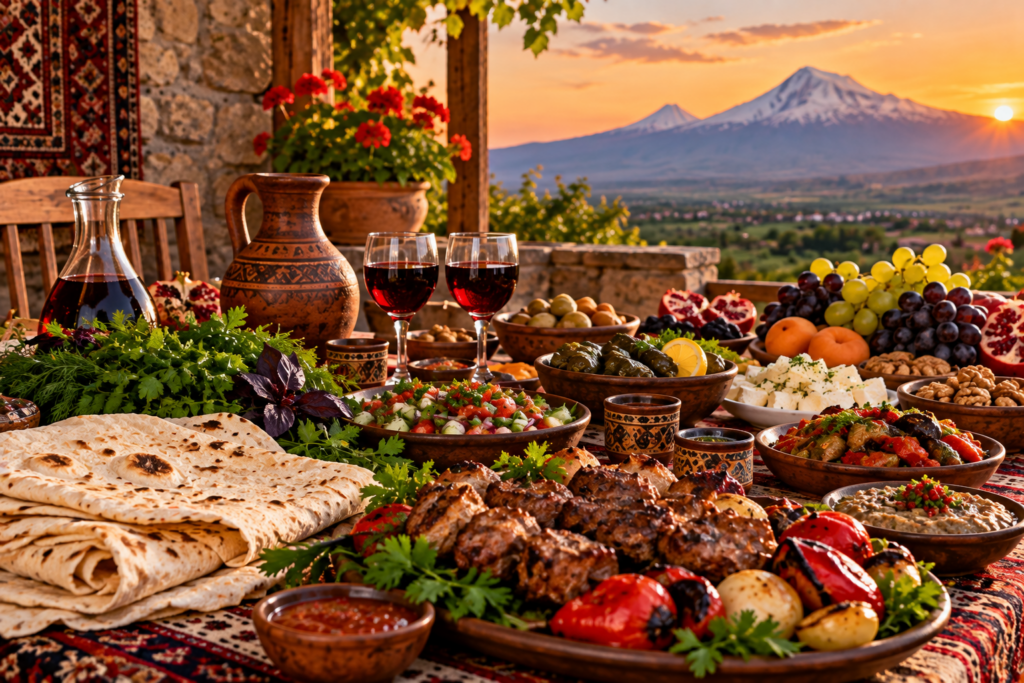
One of the most entertaining mistakes a visitor can make is assuming that everything already on the table is the entire meal.
It often is not.
Bread, cheese, herbs, vegetables, salads, pickles and small dishes may appear first.
Then comes the hot food.
Then something else.
And sometimes something else after that.
Armenian meals are often designed for sharing rather than strict individual courses.
This means the table can feel abundant from the beginning and become even fuller as the meal continues.
4. Refusing Food Once May Not End the Conversation
“No, thank you” can occasionally be interpreted as “ask me one more time.”
This is usually not meant as pressure.
Offering more food is one of the ways hosts show care.
If you genuinely cannot eat more, be warm but clear.
A smile and a sincere compliment about the meal usually help.
You can also leave a small amount of food on your plate when you are finished, rather than clearing everything immediately. Armenia Travel even notes that leaving a little food or drink can help signal that you do not need another refill.
5. Toasts Are Part of the Experience
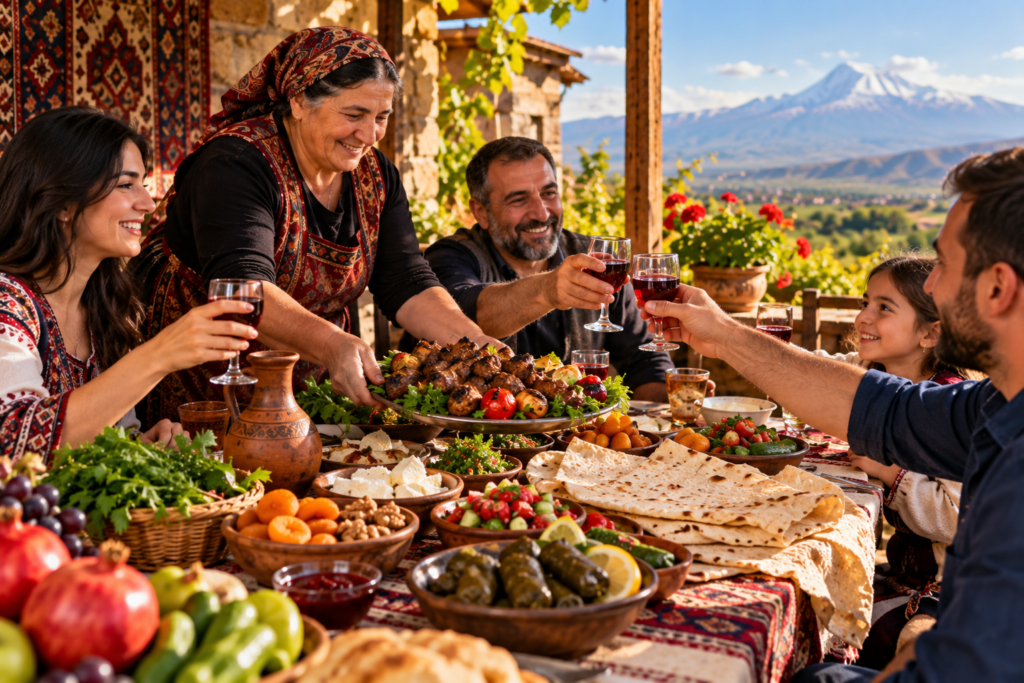
If alcohol is served, especially during a longer meal or celebration, expect toasts.
They may be dedicated to family, friendship, health, peace, guests or future meetings.
Some will be short.
Others may become miniature speeches.
Do not worry if you are not naturally good at making toasts.
You are not expected to produce a masterpiece.
A simple, sincere sentence is enough.
For example, thanking your hosts and wishing health to the family will usually be perfectly appropriate.
6. Coffee Is Often a Social Ritual, Not Just a Drink
Armenian coffee is small, strong and closely connected with conversation.
It is commonly served after a meal or during visits.
But the important part is often not the coffee itself.
It creates another reason to remain at the table.
Conversation continues.
Sweets appear.
Someone may bring fruit.
And leaving suddenly can feel strangely abrupt when everyone else has settled into the next stage of the visit.
If you are in a hurry, it is better to mention that gently earlier rather than trying to escape suddenly after the coffee arrives.
7. Guests Are Often Given the “Best” of Everything
A host may offer you the best chair, the biggest portion, the freshest fruit or the most comfortable place in the room.
At a guesthouse, you may discover that the owners have prepared far more breakfast than you expected.
In a village, someone may bring out homemade cheese, preserves or wine specifically because visitors have arrived.
Armenia’s official tourism site describes local guesthouses as especially intimate places where families often provide home-cooked food and a glimpse into everyday culture.
This generosity is part of the social role of being a host.
8. Conversation May Become Personal Quickly
In some cultures, people keep conversation with new acquaintances fairly neutral.
In Armenia, conversations can become personal surprisingly quickly.
People may ask where you are from, whether you are married, whether you have children, what you think of Armenia or where you are traveling next.
Usually, these questions are intended as interest rather than intrusion.
You are still free to answer briefly or steer the conversation elsewhere.
The important thing is not to assume that personal curiosity automatically means bad manners.
9. Hospitality Is Especially Visible Outside Formal Tourist Settings
Hotels and restaurants can certainly be warm and welcoming.
But some of the strongest hospitality experiences happen outside formal tourism.
A guesthouse owner may invite you to join the family meal.
A village producer may insist that you taste something before buying it.
A roadside stop can turn into a conversation.
A local family may offer coffee simply because you asked for directions.
These small interactions are part of why Armenia can feel different from destinations where visitor experiences are more tightly commercialized.
10. Food and Hospitality Are Difficult to Separate
In Armenia, feeding a guest is often one of the clearest expressions of care.
This is why hospitality and cuisine overlap so strongly.
Lavash, tolma, khorovats, fruit, cheese, preserves and homemade dishes are not only food items.
They become part of the act of welcoming someone.
That is also why guesthouses and gastro yards can be so memorable: they combine regional food with direct contact with local families and producers.
11. You Do Not Have to Accept Everything
Being respectful does not mean saying yes to everything.
If you do not drink alcohol, simply say so politely.
If you have dietary restrictions, explain them clearly.
If you cannot stay long, mention that before the meal grows into a three-hour visit.
If you are full, say thank you and be sincere about how much you enjoyed the food.
Most hosts care more about your comfort than about forcing you to follow a ritual perfectly.
12. A Little Armenian Goes a Long Way
You do not need to speak Armenian to be welcomed warmly.
But a few words can transform the atmosphere.
Բարև — Barev — Hello
Շնորհակալություն — Shnorhakalutyun — Thank you
Շատ համեղ է — Shat hamegh e — It is very delicious
Կենաց — Kenats — Cheers / a toast
Even imperfect pronunciation often produces a smile.
How to Be a Good Guest in Armenia
- Bring a small gift if you are invited to someone’s home.
- Do not arrive with a completely full stomach.
- Compliment the food honestly.
- Expect the meal to take longer than planned.
- Do not worry if you are offered food more than once.
- Be clear and polite about alcohol or dietary restrictions.
- Listen to toasts and join in when you feel comfortable.
- Do not treat the visit like a transaction — conversation is part of the experience.
Where Travelers Can Experience Armenian Hospitality
You do not need a personal invitation from a family to experience this side of Armenia.
Staying in locally run guesthouses is one of the easiest options.
These accommodations are common both in cities and rural areas and often include homemade breakfasts or dinners.
Gastro yards are another good choice. Many focus on regional specialties and combine meals with cooking demonstrations, farm products or workshops.
Cooking experiences can also provide a more structured introduction to traditions such as lavash or tolma preparation.
Why Armenian Hospitality Stays in Your Memory
It is easy to photograph a monastery.
It is easy to remember the name of a famous lake.
Hospitality is harder to photograph.
It exists in small moments.
Someone puts another piece of lavash on your plate.
A host brings out homemade jam that was not originally on the table.
A short coffee turns into a long conversation.
A stranger becomes someone whose family you are suddenly discussing over dinner.
That is what makes Armenian hospitality memorable.
It is not simply friendliness.
It is the feeling that, for a little while, you are no longer being treated only as a visitor.