Most visitors come to Yerevan looking up.
They look toward Mount Ararat, climb the Cascade, admire the pink stone of Republic Square and photograph balconies, fountains and old façades. Yet some of the city’s most unusual architecture is hidden in exactly the opposite direction — beneath their feet.
Yerevan Metro is small enough that many travelers think of it simply as a convenient way to get from one part of the city to another. Buy a ride, go downstairs, board the train, get off and continue sightseeing.
That is a mistake.
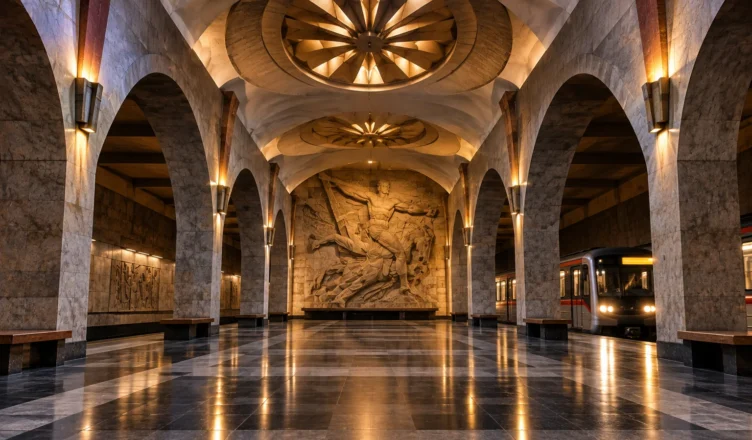
Several Yerevan metro stations are miniature architectural experiences of their own: monumental escalators, Armenian stone, Soviet modernism, unexpected sculptural details and entrances that look nothing like ordinary subway stations.
The next time you enter the Metro, do not immediately look for the train.
Look around first.
A Small Metro With a Surprisingly Big Personality
Yerevan Metro opened in 1981. Today its network is compact: just over 12 kilometers of track and 10 stations.
That may sound modest compared with the enormous underground systems of Moscow, Paris or London.
But size is not what makes Yerevan’s Metro interesting.
Its character comes from the period in which it was created.
The first stations appeared during an era when public architecture was meant to do more than solve a practical problem. A metro station could also function as a monument, a piece of urban design and even a place for art.
In Yerevan, architects combined Soviet modernism with materials and visual references that immediately connect the underground spaces with Armenia.
Stone surfaces, geometric shapes, monumental reliefs and dramatic escalator shafts make several stations worth visiting even if you have nowhere in particular to go.
Yeritasardakan: An Escalator That Seems to Continue Into the Sky

If you want to understand why Yerevan Metro deserves more attention, start with Yeritasardakan, meaning “Youth.”
The station is located near the intersection of Abovyan and Isahakyan streets, in an area surrounded by universities, cafés and cultural institutions.
But the most memorable part begins before you even reach the platform.
The entrance pavilion is one of Yerevan’s striking examples of Soviet-era modernism.
Its unusual cylindrical form appears to continue the line of the escalator tunnel upward. Seen from the right angle, the structure gives the impression that the escalator has broken through the ground and is pointing directly toward the sky.
It almost resembles a launch tube.
The effect is especially interesting because there is very little decoration competing for attention. The architecture itself creates the drama.
Inside, the station uses light gray marble and basalt, while a sculptural high relief titled “Youth” reinforces the idea behind the station’s name.
Most passengers walk through all of this in seconds.
Travelers interested in architecture should do the opposite.
Stop.
Turn around.
Look back toward the entrance and notice how the escalator, ceiling and exterior structure visually connect.
It is one of those details that becomes obvious only after someone tells you to look for it.
Republic Square: The Metro Entrance That Does Not Feel Like a Metro Entrance
Few tourists miss Republic Square.
Almost everyone visiting Yerevan eventually finds themselves standing between its monumental government buildings, fountains and distinctive pink stone façades.
But considerably fewer visitors pay attention to the architecture of the nearby Republic Square Metro station.
From above, the entrance complex has been compared to a giant stone flower.
Instead of disappearing immediately into a closed underground lobby, visitors encounter an open architectural composition with a fountain at its center.
That transition is unusual.
You are still connected to the sky and the city even though you are entering an underground transport system.
The station was designed by prominent Armenian architects Jim Torosyan and Mkrtich Minasyan, and its entrance reflects an idea seen elsewhere in Yerevan: public infrastructure does not have to be visually separate from public space.
For tourists staying in central Yerevan, this is perhaps the easiest station to explore.
Instead of rushing through it on the way to your next destination, spend several minutes walking around the entrance first.
Then go underground.
The contrast between the open exterior composition and the enclosed station below is part of the experience.
Sasuntsi David: Armenia’s Epic Goes Underground
For something completely different, ride to Sasuntsi David.
Above ground, the area is dominated by one of Yerevan’s most recognizable monuments: the dramatic equestrian statue of David of Sasun near the railway station.
But the story continues underground.
Inside the Metro station, travelers can find a series of tuff bas-reliefs inspired by episodes from the Armenian national epic “Daredevils of Sassoun.”
The reliefs depict figures and scenes associated with the legendary heroes, including David and Mher.
This is where Yerevan Metro becomes more than transportation.
A commuter rushing to a train may barely notice the sculptures. A visitor who deliberately searches for them discovers something resembling a small underground gallery.
Look closely at the material as well.
The use of Armenian tuff gives the artworks a direct visual relationship with the city above, where volcanic stone defines so much of Yerevan’s architecture.
You do not need to know the entire epic to appreciate the reliefs.
But knowing why they are there changes the station completely.
Suddenly the Metro is telling a story about Armenia.
Barekamutyun: Monumental Scale Beneath an Ordinary Intersection
Barekamutyun, or “Friendship,” is another station that visitors frequently use without really seeing.

Above ground, the surrounding area is busy, noisy and intensely practical — shops, traffic, buses, pedestrians and underground passages moving in every direction.
Below ground, the atmosphere changes.
The station belongs to the original group of Yerevan Metro stations and reflects the monumental style that characterized the early system.
This is a good place to notice something that is easy to miss throughout the Metro: proportion.
Look at how wide corridors feel compared with the relatively small number of passengers.
Notice the depth, long visual axes and transition from street-level chaos to the calmer geometry below.
Not every memorable piece of architecture needs a famous sculpture.
Sometimes the space itself is the attraction.
Marshal Baghramyan: A Station Tourists Rarely Visit for the Station
Many travelers arrive at Marshal Baghramyan because they are heading toward one of the institutions, parks or streets nearby.
Few arrive specifically to examine the Metro.
That is precisely why it fits this underground tour.
Together with Barekamutyun, Yeritasardakan and Sasuntsi David, Marshal Baghramyan was part of the first section of the system.
The station is another reminder that Yerevan’s underground network was conceived as a coherent architectural project rather than a collection of purely functional platforms.
If you enjoy photographing symmetry, repeating structural elements and long perspectives, stop here instead of remaining on the train.
You may find that some of the most atmospheric photographs of Yerevan contain no mountains, churches or pink buildings at all.
What Should You Actually Look For?
The trick to enjoying the Yerevan Metro is simple:
stop treating it like transportation for half an hour.
Once you do that, small details begin appearing everywhere.
Watch for the transition between Armenian stone and more industrial materials.
Look at lamps and ceiling structures.
Notice how escalator tunnels frame the people moving through them.
Look for reliefs, ornaments and lettering.
Stand at the far end of a platform and examine its symmetry.
And perhaps most importantly, look back after using an escalator.
Architecture designed around movement often looks completely different when viewed in the opposite direction.
A Simple Underground Architecture Route
You do not need an entire day to explore Yerevan’s Metro.
A compact architectural route could look like this:
Barekamutyun → Marshal Baghramyan → Yeritasardakan → Republic Square → Sasuntsi David
Do not rush through all five.
Get off at each station, explore the public areas and then continue with the next train.
If you are short on time, concentrate on three:
Yeritasardakan for modernism.
Republic Square for the relationship between Metro architecture and public space.
Sasuntsi David for Armenian monumental art.
The result is an unusual miniature sightseeing tour that takes place mostly underground.
And because many tourists never think of doing it, it provides a very different perspective on the city.
Photography Tips
Metro photography requires a different approach from photographing Yerevan’s outdoor attractions.
Wide compositions work especially well because the architecture often depends on symmetry and perspective.
Escalators can create strong leading lines.
A single person walking through a large hall can help show the scale of the station.
Architectural details are often more interesting than trains themselves.
Whenever possible, avoid the busiest commuting periods. Exploring a station is much easier when you are not standing in the middle of a crowd trying to reach work or home.
And naturally, respect passengers who may not want to be photographed.
The objective is not to turn commuters into attractions.
It is to notice the architecture around them.
Do Not Ignore the Escalators
This deserves its own rule.
In many cities an escalator is simply the boring part between the street and the platform.
In Yerevan, it can be part of the architecture.
Some rides underground are long enough to create a strange moment of separation from the city outside.
Traffic disappears.
Sunlight disappears.
The sounds change.
For a minute you are suspended between two versions of Yerevan — the bright city of cafés, stone façades and busy streets above, and the quieter monumental city underneath.
Put the phone away for one escalator ride.
Just look.
The Metro Is Also a Time Capsule
Cities constantly rebuild themselves.
Shops change. Cafés disappear. Buildings are renovated. Street signs and advertisements are replaced.
Underground architecture often changes more slowly.
That makes older Metro stations particularly interesting.
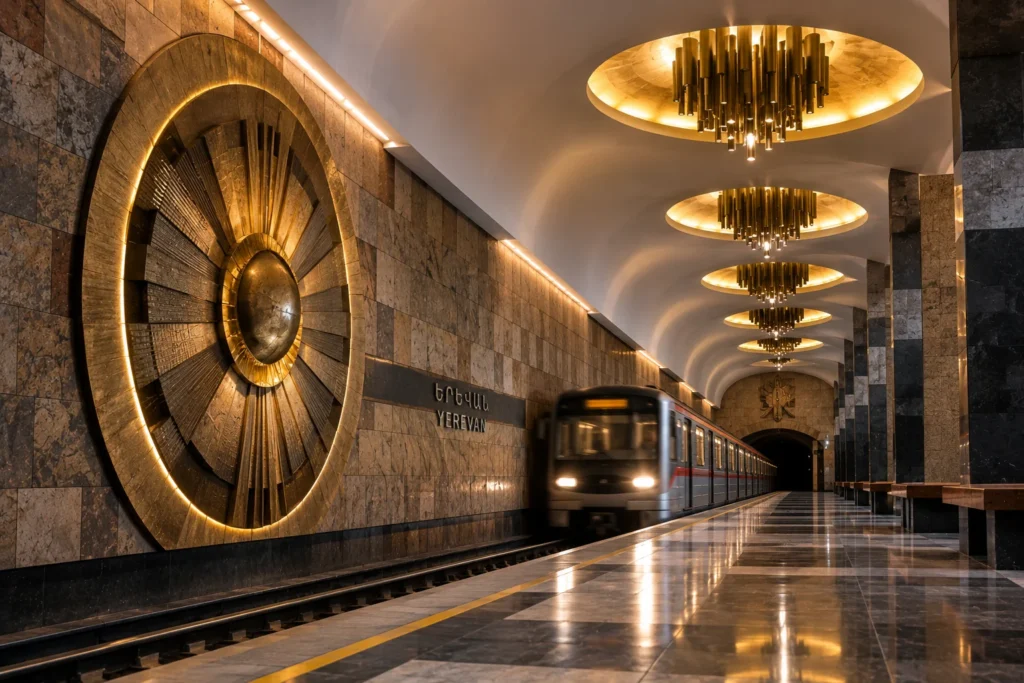
They preserve ideas about how architects once imagined the future of Yerevan: monumental, modern, efficient and still recognizably Armenian.
Of course, the Metro is not frozen in 1981. The system has undergone modernization, including work on stations, infrastructure and escalators.
Yet the architectural identity of its best-known stations remains visible.
You are not visiting a museum.
You are seeing historical design still performing its original everyday function.
That is what makes it special.
One of Yerevan’s Cheapest Sightseeing Experiences Is Beneath Your Feet
Visitors sometimes believe that discovering a city requires constantly searching for new attractions.
Yerevan rewards a different strategy.
Sometimes the attraction is a place you were already planning to pass through.
The Metro carries thousands of people beneath the city, and most of them understandably have somewhere to be.
You, however, are traveling.
You have the luxury of looking.
So the next time you descend into Yerevan Metro, resist the instinct to immediately check the platform sign or your phone.
Look at the walls.
Look at the stone.
Look at the sculptures.
Look back toward the escalator.
The Yerevan that most tourists photograph is above ground.
But another Yerevan has been waiting underneath it since 1981.