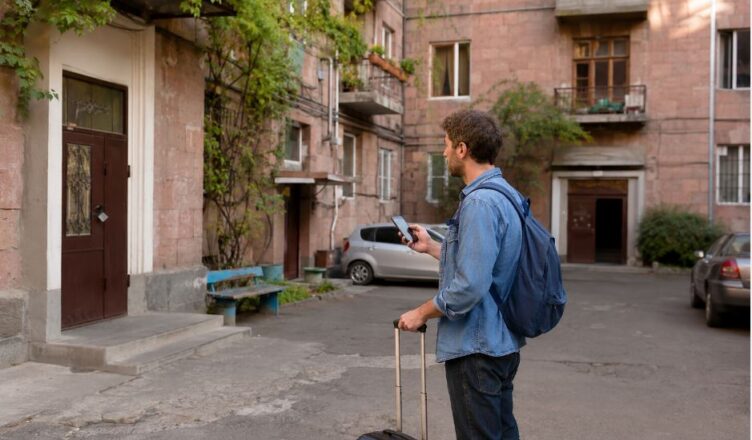
You have arrived at the exact point shown on your map. The street name is correct, the building number matches your reservation, and your phone insists that the destination is only a few meters away.
Yet the apartment entrance is nowhere to be seen.
Instead, you find a pharmacy, a locked metal gate, an archway leading into a courtyard and three doors that appear to belong to different buildings. Your host says, “Come through the second entrance from the yard,” but you are still standing on the street wondering which yard they mean.
This is a surprisingly common first-day experience in Yerevan.
The city is not impossible to navigate, but its residential addresses do not always lead directly to the door you need. One street address may cover several entrances, interconnected buildings or a structure hidden behind the visible façade.
Once you understand how Yerevan’s buildings, entrances and courtyards work, the confusion becomes much easier to solve.
The Address Often Identifies the Building, Not the Entrance
In many modern cities, entering an address into a navigation app takes you directly to the main door.
Yerevan is not always that simple.
An address may bring you to the correct building while the actual residential entrance is located:
- around the corner,
- on a parallel street,
- behind a shop,
- inside a courtyard,
- beneath an archway,
- at the back of the building,
- or beside an entrance that looks completely unrelated.
This happens particularly in older parts of central Yerevan, where buildings have changed over time. Ground-floor apartments may have become cafés or shops, courtyards may connect several structures, and entrances originally designed for residents may no longer face the main street.
Your map can therefore be geographically correct while still being practically unhelpful.
The blue location dot tells you where the building is. It does not necessarily tell you how to enter it.
Why Yerevan’s Courtyards Matter
A courtyard in Yerevan is rarely just decorative space between buildings.
It can function as a residential passage, parking area, social space and access point for several entrances at once. Some courtyards are open to the street through a wide arch. Others are reached through a narrow passage that a first-time visitor may easily mistake for a private entrance.
Once inside, the architecture can become even more complicated. One courtyard may contain:
- several stairwell entrances,
- doors leading to different wings,
- a second building behind the first,
- exterior staircases,
- balconies connecting different sections,
- and another passage opening onto a different street.
This is why a host may tell you, “The entrance is from the courtyard,” as if that explains everything. For a local resident, it probably does. For a visitor looking at four nearly identical doors, it may not.
Do not assume that entering the correct courtyard means you have found the correct entrance. Ask for one more identifying detail.
The Most Important Question Is Not “What Is the Address?”
Before travelling to an apartment, guesthouse, office or private home, ask:
Where exactly is the entrance?
A complete set of arrival instructions should ideally include:
- the street address,
- a map pin,
- whether the entrance is from the street or courtyard,
- the entrance or stairwell number,
- the floor,
- the apartment number,
- the intercom code,
- and one visible landmark near the correct door.
A landmark is often more useful than a formal address. “Enter through the arch beside the bakery and use the brown door on the left” may guide you more effectively than repeating the building number.
If your host sends only an address, request a photograph of the entrance. A single image can eliminate ten minutes of searching.
Slashes and Additional Building Numbers
Yerevan addresses sometimes contain a slash or a second number, such as 10/2.
Do not automatically interpret this as an apartment or entrance number. It may identify a separate structure, building section or address within a larger property.
Navigation services may place several related numbers at nearly the same point. The result can be a map pin near the correct complex but not near the door you need.
When your booking includes a slash number, copy the complete address exactly. Do not shorten it when ordering a taxi, arranging a delivery or asking a local for directions.
If the driver or courier calls to confirm the location, repeat both numbers and mention the nearest recognizable business, intersection or courtyard entrance.
One Building Can Have Several Entrances
Large apartment buildings frequently contain multiple stairwells. Each one serves a different group of apartments, and there may be no internal passage connecting them.
Entering the wrong stairwell does not simply mean taking another corridor. You may need to return outside, walk around the building and find an entirely different door.
Entrance numbers are not always large, new or easy to see. They may be:
- painted near the door,
- displayed on a small plate,
- attached to an intercom,
- faded by weather,
- hidden behind a gate,
- or absent altogether.
Apartment numbers can sometimes help determine the correct stairwell, but visitors should not rely on guessing. Buildings do not all follow the same arrangement.
Ask your host for the entrance number and a visual description of the door.
The Front of the Building May Not Be the Useful Side
The most impressive façade is not necessarily where residents enter.
A central Yerevan building may present elegant pink-stone architecture to the avenue while its everyday entrances face a quieter courtyard behind it. Shops and restaurants may occupy the street level, leaving no obvious residential door on the main side.
This can create the strange feeling that your accommodation does not exist. You see the correct building but cannot find any entrance that resembles the booking photographs.
Look for an arch or passage between businesses. Walk a short distance around the corner and check whether the same building continues along another street.
If you are carrying heavy luggage, do not circle the entire block immediately. Contact your host and ask them to describe the route from your current position.
A photo of the storefront or arch in front of you can help them understand exactly where you are.
Street Names May Appear in Different Forms
A single Yerevan street can appear differently across booking platforms, map applications and messages.
You may encounter:
- Armenian spelling,
- English transliteration,
- Russian spelling,
- abbreviated street names,
- and slightly different Latin-letter versions of the same Armenian name.
For example, one application may use “street,” another may write “St.,” and a local message may present only the Armenian name followed by the building number.
Transliteration can also vary. Two spellings that look different to a foreign visitor may refer to the same place.
The safest method is to save:
- the complete address from the booking,
- the location pin supplied by the host,
- the Armenian version of the address,
- and a screenshot of the entrance.
The Armenian version is especially useful when asking an older resident, shopkeeper or taxi driver for help.
A Map Pin Is Often Better Than a Typed Address
When travelling to a residential location, ask the host to send a direct map pin rather than only a written address.
But even a pin has limitations.
It may indicate:
- the center of the building,
- the street façade rather than the courtyard,
- the roof of a large complex,
- or the nearest point recognized by the mapping service.
Use the pin to reach the general location, then switch to the host’s entrance instructions.
For taxis, place the destination marker near the actual access point when possible. If the entrance is inside a courtyard, it may be better to meet the driver at the closest street opening rather than expect the car to enter.
Large courtyards can contain narrow turns, parked vehicles or gates that make vehicle access difficult.
What to Send a Taxi Driver or Courier
If a driver or delivery courier needs to find you, sending only the apartment number is rarely enough.
Provide information in this order:
- street and building number,
- nearest intersection or visible business,
- courtyard access point,
- entrance number or door description,
- floor and apartment,
- intercom instructions.
When waiting for a taxi, stand where a car can legally and safely stop. A pin placed inside a building or deep in a courtyard may cause the driver to stop on the opposite side of the block.
Check the direction in which the vehicle is approaching. If the street has separated lanes or limited turning options, crossing to the driver’s side may save several minutes.
For food deliveries, mention whether the courier should call from the street, enter the courtyard or bring the order directly to the apartment.
Learning a Few Armenian Words Helps
You do not need to speak Armenian to find an address in Yerevan. However, a few practical words can make a confusing situation much easier.
- Hasce — address
- Poghots — street
- Poghota — avenue
- Shenk — building
- Mutk — entrance
- Bak — courtyard
- Hark — floor
- Bnakaran — apartment
- Kod — code
- Aj — right
- Dzakh — left
You can also show the written address on your phone and ask:
“Khndrum em, vortex e ays hascen?”
“Excuse me, where is this address?”
Even if your pronunciation is imperfect, most people will understand what you need.
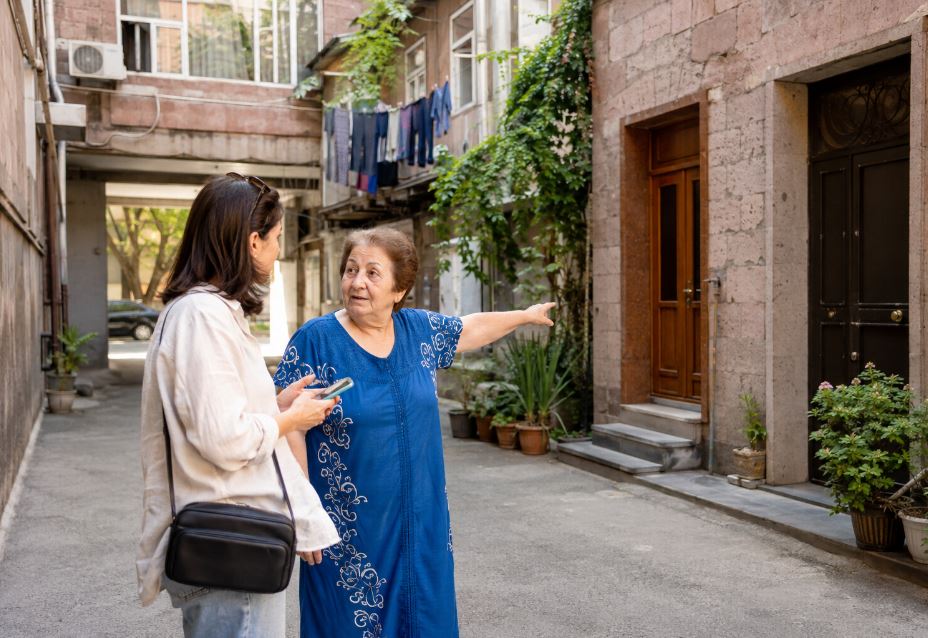
A resident may answer in Armenian or Russian and use hand gestures to show the route. Pay attention to where they point. Directions such as “through the arch, then right” are often easier to understand visually than verbally.
Floors Can Cause Another Small Surprise
In most Yerevan residential buildings, the level reached directly from the entrance is considered the first floor.
Visitors from countries where the street level is called the ground floor should keep this difference in mind. If you are told that an apartment is on the third floor, you may climb fewer flights than you expected.
Not every older building has an elevator. Even when one exists, it may be small and unsuitable for several people with large suitcases.
Before booking, ask about elevator access if stairs would be difficult for you. Do not assume that a central apartment in a multi-storey building automatically includes a modern lift.
Intercoms Are Not Always Self-Explanatory
Many residential entrances use intercom systems, coded locks or both.
The apartment number and intercom button may not match in an obvious way. Some systems require a specific sequence, while others are old enough that labels have faded.
Ask the host to provide exact instructions:
- which button to press,
- whether to enter a code first,
- whether the door opens automatically,
- and what to do if the intercom does not work.
Save these instructions before leaving the airport or railway station. Mobile internet problems feel much more serious when you are standing outside a locked door with luggage.
Never repeatedly press several apartment buttons hoping someone will open the entrance. If your host is not answering, wait briefly and send a clear message describing your location.
Arriving After Dark Requires More Preparation
A courtyard that feels obvious during the day can become confusing at night.
Entrance numbers may be poorly lit, shops used as landmarks may be closed, and several doors can look nearly identical. Your phone battery may also be low after a day of travelling.
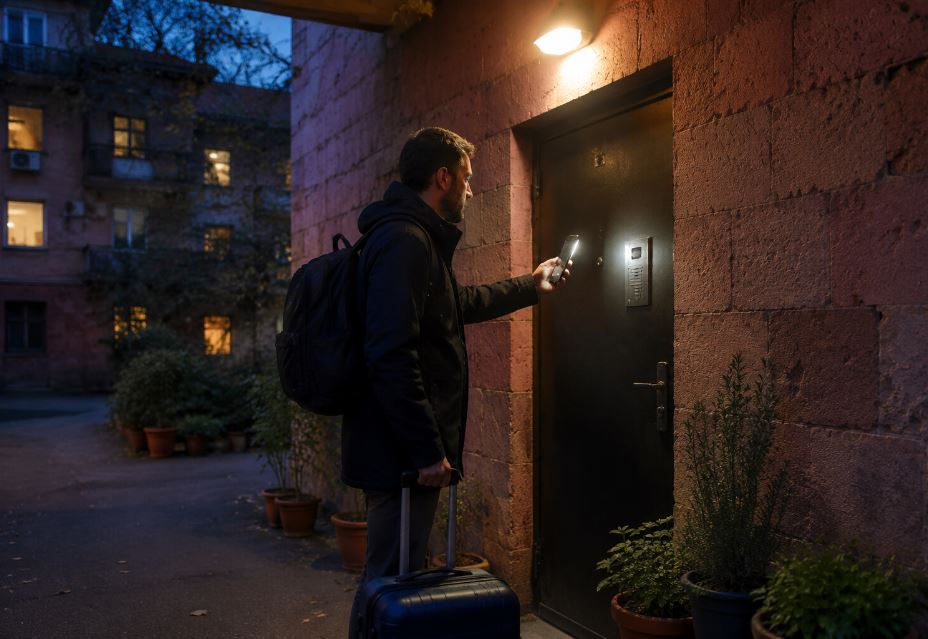
For a late arrival:
- download the map area in advance,
- take a screenshot of the route and entrance,
- keep the host’s phone number accessible,
- carry a charged power bank,
- confirm the intercom code,
- and ask whether the courtyard gate is locked at night.
If possible, arrange for the host to meet you outside during a very late first arrival. Once you have entered the building successfully, finding it again will feel much simpler.
Ask a Shopkeeper, Not a Moving Crowd
When you are close to the address but cannot identify the entrance, ask someone who knows the immediate area.
A nearby shopkeeper, security guard, building resident or café employee is often more helpful than a pedestrian who is simply passing through.
Show the full address rather than trying to pronounce an unfamiliar street name from memory. If you have an entrance photograph, show that too.
Residents frequently recognize their building from a small architectural detail, doorway or courtyard wall.
Keep in mind that people may point toward a passage you have already dismissed. In Yerevan, the narrow arch beside a shop may genuinely be the route to an entire residential courtyard.
Respect the Courtyard as a Living Space
Yerevan’s courtyards can be visually fascinating. You may see old balconies, stone staircases, vines, cats, handmade benches and traces of several architectural periods.
But these are not open-air museum exhibits. They are places where people live.
When looking for an entrance:
- keep your voice low at night,
- avoid photographing residents without permission,
- do not enter private staircases unnecessarily,
- do not block gates with luggage,
- and close any door that was closed when you arrived.
If you accidentally enter the wrong courtyard, simply return to the street. There is no need to explore every passage in search of a shortcut.
Respectful behavior matters more than finding the fastest route.
What to Do When the Pin and Address Disagree
Occasionally, the written address and map pin may appear to lead to different places.
Do not choose one at random. Contact the host and send screenshots of both locations.
Ask one direct question:
“Should I follow the written address or the pin?”
The difference may have a simple explanation. The address could refer to the building’s official street side, while the pin indicates the practical courtyard entrance.
For a hotel or established guesthouse, search for its name as well as its address. For a private apartment, rely more heavily on the host’s live instructions and entrance photograph.
If you remain uncertain, ask the host to share their live location or meet you at a nearby landmark.
A Simple Arrival Checklist
Before travelling to any private address in Yerevan, save the following:
- the complete address,
- the address written in Armenian,
- a precise map pin,
- a photograph of the entrance,
- courtyard directions,
- the entrance number,
- the floor and apartment number,
- the intercom code,
- the host’s phone number,
- and the name of a nearby landmark or business.
Keep this information available offline.
The checklist may seem excessive while you are sitting comfortably at the airport. It will feel extremely useful when your taxi leaves and you realize that the door is on the other side of the building.
If You Still Cannot Find the Place
Stop walking in circles and choose a clear point where your host can find you.
Stand beside a recognizable shop, intersection, monument or building corner. Send a photograph of what you see and share your live location if possible.
If the problem is broader than one apartment—for example, you need a city map or help understanding an area—Yerevan has official tourist information centers near Republic Square and France Square. Their staff provide assistance in several languages. Official Yerevan tourist information centers
The city’s official tourism website also provides a downloadable thematic map covering major attractions and useful urban locations. Official thematic map of Yerevan
Final Thoughts
Yerevan addresses are not deliberately mysterious. They simply reflect how the city has grown.
Historic façades, Soviet apartment blocks, later additions, converted ground floors and interconnected courtyards have created a city where the official address and the practical entrance are sometimes two different pieces of information.
The solution is not to distrust your map. It is to collect better arrival details.
Ask for the courtyard, entrance, floor, code and one visible landmark. Save the address in Armenian, request a photograph of the door and keep the host’s phone number available offline.
After finding the correct entrance once, the route will probably seem completely obvious.
That is one of Yerevan’s small urban lessons: sometimes the city does not hide the destination—it simply expects you to look beyond the street-facing door.