Most travel guides tell you what to see in Armenia.
They show you monasteries, mountains, museums, streets, viewpoints and restaurants. And of course, all of those things matter. But after spending time in Yerevan and traveling beyond the capital, I realized that some of my strongest memories of Armenia are connected to something photographs cannot capture.
They are connected to sound.
The splash of cold water from a street fountain. The sharp click of backgammon pieces against a wooden board. A seller calling to customers in a busy market. Church bells echoing through stone walls. The low hum of conversation from an open courtyard. And, outside the city, the kind of silence that makes you suddenly notice the wind.
If you want to experience Armenia more deeply, try listening to it.
Yerevan Sounds Different Early in the Morning
Yerevan is often described as a lively city, but early in the morning it has a completely different character.
Before traffic becomes heavy and café terraces fill with people, the city feels softer.
You may hear birds in the trees, workers preparing shops for the day, delivery vehicles stopping near small stores, brooms brushing against sidewalks and the distant sound of buses starting their routes.
In central Yerevan, even streets that become crowded later can feel surprisingly calm around 7:00 or 8:00 in the morning.
This is one of my favorite times to walk.
There is no need to rush from attraction to attraction. Simply choose a familiar street and notice how different it feels before the city fully wakes up.
For travelers who enjoy photography, early morning is also useful because streets are usually less crowded. But even without a camera, it is worth experiencing Yerevan at this hour simply for the atmosphere.
The Sound of Water Is Part of Yerevan
One sound appears again and again while walking through Yerevan: running water.
Public drinking fountains, known locally as pulpulaks, are part of everyday life in the city.
They are small, practical and easy to overlook if you are focused only on major landmarks. Yet for locals, they are completely normal. Someone stops for a quick drink. Another person fills a bottle. A child plays with the water for a moment before being called away.
In summer, the sound of cool running water feels especially connected to Yerevan.
For visitors, pulpulaks are more than convenient drinking fountains. They are an example of how public space works here.
You do not need to plan a special visit to see one. You will encounter them naturally while walking.
That is exactly why I like them.
They belong to daily life rather than to a tourist checklist.
Traveler tip
Carry a reusable bottle while exploring Yerevan. It is useful in hot weather and makes it easier to take advantage of public drinking fountains when you encounter them.
Markets Have Their Own Rhythm
Markets are among the best places to hear the everyday rhythm of Armenia.
The first thing you notice is often not what people are selling, but how much conversation is happening around you.
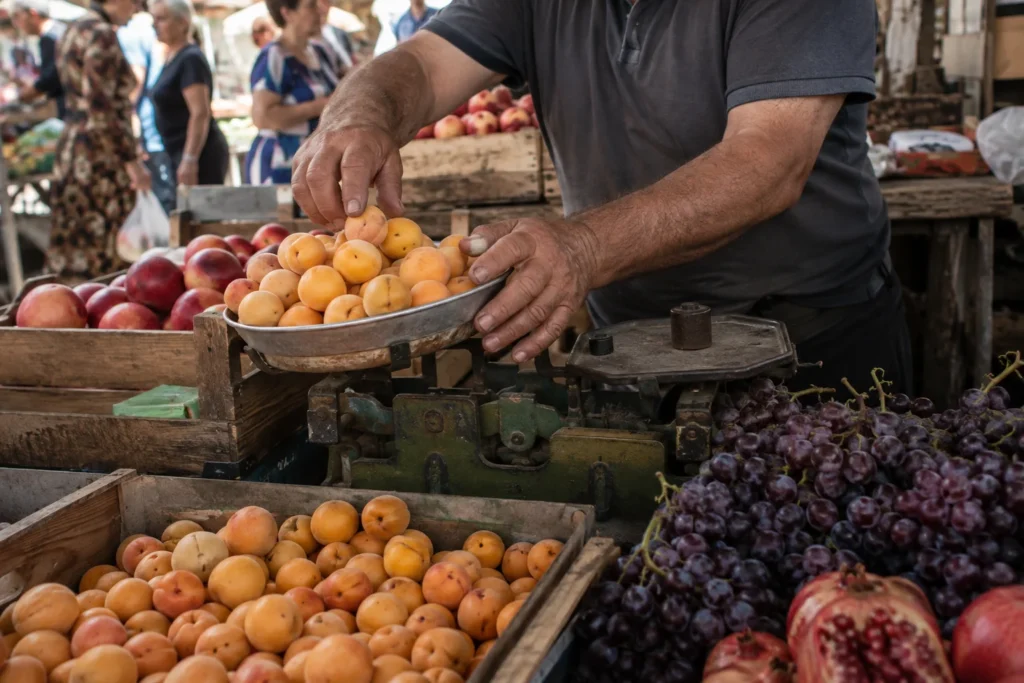
Prices are discussed. Questions are asked. Vendors greet regular customers. Bags rustle. Boxes move. Fruit is weighed. Someone cuts a small piece for a customer to taste.
Even if you do not understand Armenian, the energy is easy to recognize.
A market is not a museum.
People are working there, buying food and going about their daily routines. That is why visitors should approach these places with respect.
Do not block narrow passages for long photo sessions. If you want a close photograph of a person, it is better to ask first. And if a seller offers you something to taste, a smile and a simple thank you go a long way.
One of the most interesting things about Armenian markets is that they can feel both practical and social.
People do not always arrive, buy something and immediately leave. Conversations can continue. Familiar customers stop to exchange news. Shopping becomes part of daily social life.
You can learn a lot about a city simply by standing quietly and observing this rhythm.
Backgammon Has a Sound You Start Recognizing
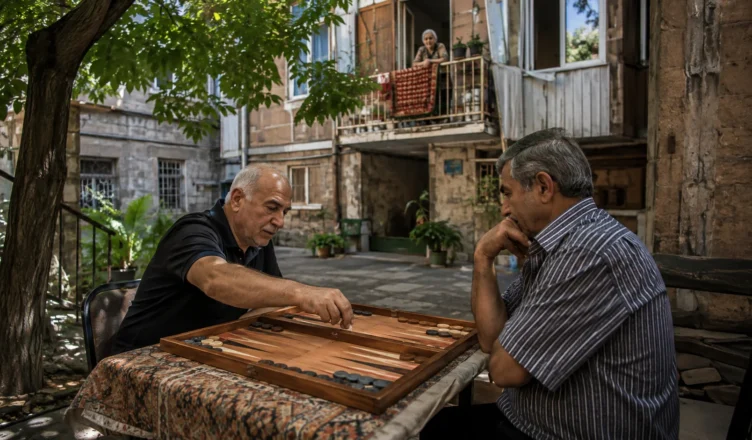
There is one sound that I now associate strongly with Armenia: the click of backgammon pieces.
Backgammon, or nardi, is widely played in Armenia.
You may see people playing in courtyards, cafés, parks or private homes. But sometimes you hear the game before you actually notice the players.
The wooden pieces hit the board with a quick, confident sound. Dice roll. Someone reacts immediately. A conversation continues at the same time.
The interesting part is that the game is rarely only about the game.
It is also about company.
Friends talk, joke, argue about a move and continue playing. A match can become the center of a much longer conversation.
For a traveler, watching a local game can be more revealing than visiting another monument.
It shows a quieter side of Armenian culture: competition mixed with conversation and companionship.
You do not need to know the rules to understand the atmosphere.
A Lavash Oven Is an Experience for More Than One Sense
Armenian lavash is famous, but watching it being made is very different from simply eating it in a restaurant.
Near a traditional tonir oven, everything happens quickly.
Dough is prepared and stretched. The oven radiates intense heat. The thin bread is placed against the hot inner wall and removed after baking.
There is movement, heat, conversation and the subtle crackling sound of the oven.
It is one of those experiences where smell, sound and sight come together.
If you have the opportunity to see lavash being prepared traditionally, pay attention to the process rather than only to the finished bread.
The coordination between the people making it is fascinating.
For many visitors, this becomes one of the most memorable food experiences in Armenia because it shows that food here is not simply something placed on a plate. It is connected to technique, family traditions and daily work.
Church Bells Change the Atmosphere Around You
Armenia’s churches and monasteries are usually photographed for their architecture.
Stone walls. Crosses. Ancient carvings. Mountain landscapes.
But sound can completely change the experience.
When church bells ring, the space suddenly feels different.
In a busy part of a city, the bells mix with traffic and voices. In a quiet monastery complex, they can travel much farther through open space.
Even if you visit purely for historical or architectural reasons, it is worth spending a few minutes without speaking.
Listen to the bells if they ring.
Listen to footsteps on stone.
Listen to the wind around the building.
These details help you understand why historic sites can feel so different from photographs.
A picture can show you the structure.
Sound gives you a sense of place.
Armenian Courtyards Are Full of Small Sounds
Some of the most interesting places in Yerevan are not famous landmarks at all.
They are ordinary residential courtyards.

In older parts of the city, a courtyard may contain balconies, trees, parked cars, laundry, cats and neighbors who have known each other for years.
The sounds are equally ordinary.
A door opens. Someone calls from a balcony. Children play nearby. Dishes move in a kitchen. A television is audible through an open window. Someone is discussing something with a neighbor.
None of this is designed for tourists.
That is exactly what makes it interesting.
Of course, residential courtyards should be treated as private living spaces rather than attractions. Visitors should avoid photographing residents without permission or entering areas that clearly feel private.
But when you pass through a public courtyard or see one from the street, it can reveal something important about Yerevan.
The city is not only its grand avenues.
It is also made of small spaces where daily life continues behind the main streets.
Summer Evenings Have Their Own Soundtrack
Yerevan evenings, especially during the warmer months, can be surprisingly lively.
People stay outside later. Outdoor cafés remain busy. Families walk together. Children play in public spaces. Music can drift from restaurants or from street performers.
The atmosphere changes gradually after sunset.
During the day, people may move quickly because of work or the heat. In the evening, the pace becomes more relaxed.
This is one reason I recommend walking through central Yerevan at different times of day rather than seeing everything in a single afternoon.
The same street can feel almost like a different place.
If you are visiting in summer, an evening walk is not only about cooler temperatures. It is a chance to experience how locals use the city after the working day is over.
Outside Yerevan, Silence Becomes Part of the Journey
One of the biggest changes you notice when traveling outside Yerevan is not a new sound.
It is the disappearance of sound.
Drive toward a small village, mountain road or remote monastery and eventually the traffic fades.
There may be wind.
Birds.
Water somewhere nearby.
Perhaps an occasional vehicle or the sound of animals from a village.
And then long stretches of quiet.
For visitors coming from large, noisy cities, this can be unexpectedly powerful.
Silence makes the landscape feel larger.
You begin to notice distances differently. A sound from far away suddenly seems close. The wind through grass becomes noticeable. Your own footsteps seem louder.
Some of Armenia’s most beautiful locations are impressive precisely because there is so little around them.
In those places, I recommend resisting the instinct to immediately take out your phone.
Spend a few minutes doing nothing.
It may become one of the moments you remember best.
Try This Simple Travel Challenge
The next time you explore Yerevan or travel elsewhere in Armenia, try a simple experiment.
Put your phone away for one hour.
Do not listen to music or constantly check maps unless you need them.
Instead, notice five different sounds around you.
You might hear:
- water from a pulpulak,
- backgammon pieces,
- church bells,
- market conversations,
- street music,
- birds,
- the sound of a tonir,
- children playing,
- wind in the mountains.
At the end of the hour, try to remember which sound you liked most.
It seems like a very small exercise, but it changes the way you experience a place.
You stop moving through the city only as a tourist searching for landmarks.
You start paying attention to ordinary life.
Why Sound Can Tell You More Than a Photograph
Travel photography encourages us to search for impressive views.
And Armenia certainly has plenty of them.
But some of the most authentic moments are almost impossible to photograph.
The sound of people laughing in a courtyard.
A backgammon game that becomes increasingly competitive.
Running water on a hot afternoon.
The quiet inside an old church.
The sudden silence of a mountain road.
These moments do not necessarily produce spectacular social media images.
But they often produce stronger memories.
That is why, when friends ask me how to experience Armenia beyond the usual tourist route, I do not always recommend another destination.
Sometimes I simply tell them to slow down.
Walk.
Listen.
Notice what is happening around you.
Because Armenia is not only a country you can see.
It is a country you can hear.
Practical Tips for Listening to Armenia
Walk early.
Between roughly 7:00 and 9:00 in the morning, central Yerevan is often calmer than later in the day.
Spend time in ordinary neighborhoods.
Do not limit your visit to the most famous squares and monuments.
Visit a local market.
Go not only for food, but also to observe everyday interactions.
Respect private spaces.
Courtyards and neighborhood streets are lived-in environments, not outdoor museums.
Stay quiet at religious sites.
You will notice much more when you give yourself a few minutes without conversation.
Take short breaks from your phone.
Constant navigation, photography and notifications can easily hide the atmosphere of a place.
Travel outside the capital.
The contrast between Yerevan’s urban sound and rural Armenia’s quiet is part of the experience.
Final Thought
Most travelers leave Armenia with hundreds of photographs.
Months later, however, the memory that suddenly returns may have nothing to do with a photograph.
It might be the sound of water running from a small fountain on a hot Yerevan afternoon.
The click of backgammon pieces in a shaded courtyard.
Church bells somewhere in the distance.
Or the wind on an empty road outside the city.
Those are the details that make travel personal.
And sometimes, to discover them, all you have to do is listen.