
Most first-time visitors to Armenia follow a familiar route: Yerevan, Garni, Geghard, Lake Sevan, Dilijan and perhaps Tatev. All of them are worth seeing — but they reveal only one side of the country.
Travel a little farther from the classic tourist trail and Armenia begins to feel completely different. Forest paths lead to forgotten monasteries, deep gorges hide abandoned settlements, waterfalls appear beyond quiet villages, and centuries-old churches stand in places where you may encounter only a handful of other travelers.
If you want to discover the Armenia that many visitors never see, these are the places to put on your map.
1. Kobayr Monastery — Frescoes Hidden Above the Debed Gorge

Driving through Lori, it is surprisingly easy to pass Kobayr without realizing that one of northern Armenia’s most atmospheric medieval sites is hiding above the road.
The monastery stands on the wooded slopes of the Debed Gorge near the town of Tumanyan. You cannot simply park beside the church and step out of the car. Reaching the complex involves a short uphill walk, which is part of what keeps Kobayr quieter than Armenia’s better-known monasteries.
When you finally arrive, the reward is extraordinary: ruined stone walls, surviving medieval frescoes and dramatic views through the trees toward the gorge below.
Kobayr is especially beautiful when the forest is green in late spring and summer, or when Lori turns gold and red in autumn.
Why go: medieval frescoes, forest scenery and far fewer visitors than Armenia’s most famous religious sites.
Good to know: wear comfortable shoes. The final approach is on foot and can be slippery after rain.
2. Horomayr — A Monastery Built Into the Edge of a Canyon
Not far from Odzun lies another place that feels almost impossible when viewed from across the Debed Gorge.
Horomayr is unusual because the monastic complex is divided into two sections. One sits close to the edge of the plateau, while another lies below the cliffs inside the gorge.
The setting is the real attraction. Stone churches appear to merge with the rock, while the vast landscape of northern Armenia opens around them.
This is not a quick roadside attraction. Horomayr rewards travelers who enjoy walking, silence and places that still feel connected to the landscape rather than shaped around tourism.
Best for: hikers, photographers and travelers searching for genuinely atmospheric historical sites.
3. Arevatsag Canyon — Where Three Rivers Shape the Landscape
Lori is famous for monasteries, but some of its most impressive scenery lies away from the major tour-bus routes.
Near Arevatsag, the valleys of the Dzoraget, Debed and Pambak rivers create a spectacular landscape of cliffs, green slopes and dramatic river bends.
From above, the canyon appears like a huge fracture running through the countryside. Down below, the scenery becomes wilder, with rocky sections, river views and hiking possibilities.
Spring is especially beautiful when the hills are bright green, while summer generally offers easier conditions for spending more time outdoors.
Why it feels different: there are no giant monuments demanding your attention. The landscape itself is the destination.
4. Trchkan Waterfall — Armenia’s Wild Waterfall Escape
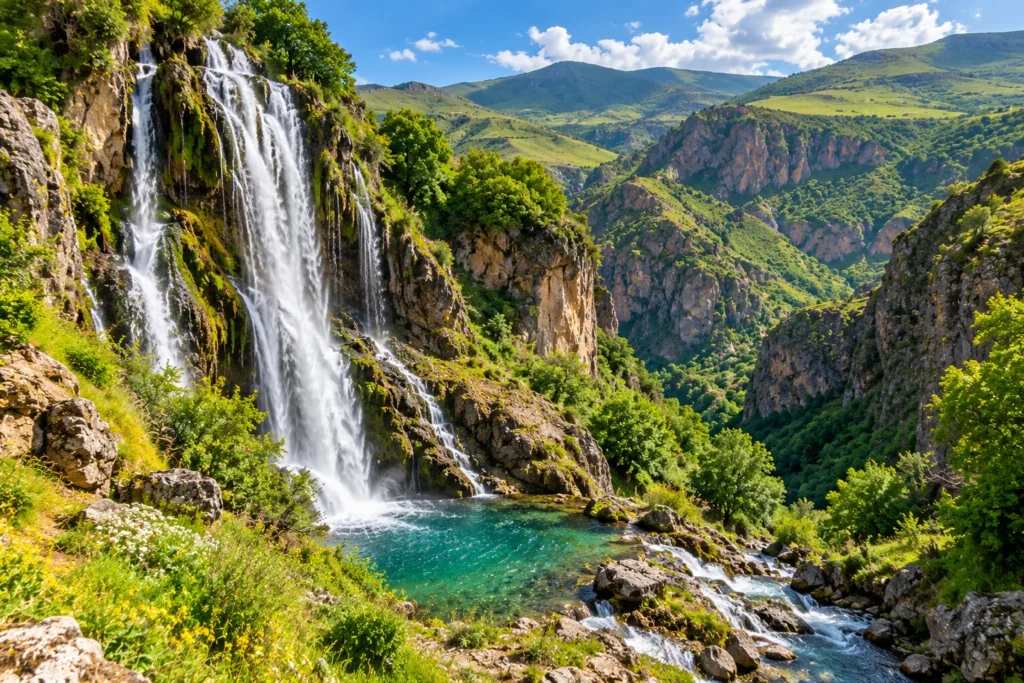
Waterfalls are not usually the first thing travelers associate with Armenia, which is exactly why Trchkan can be such a surprise.
Located in a remote area between Lori and Shirak, the waterfall feels much farther from city life than the map might suggest.
The journey takes you through open countryside before the landscape suddenly becomes greener and the sound of rushing water begins to dominate the valley.
Trchkan is especially rewarding for travelers who prefer natural landscapes to organized attractions.
Best experience: combine the visit with a picnic or short hike rather than treating the waterfall as a five-minute photo stop.
Travel tip: road and trail conditions can vary with weather, so check local conditions before setting out.
5. Old Khndzoresk — An Abandoned Village Inside a Gorge

Near Goris in southern Armenia, an entire former settlement stretches through a dramatic canyon.
Old Khndzoresk is far more than a collection of caves. For generations, people built homes, storage spaces, churches and paths into and around the rock formations of the gorge.
Today, visitors descend into the canyon and cross the suspension bridge connecting its two sides. From the bridge, caves and ruins appear across the cliffs at different levels, revealing how unusual the settlement once was.
The deeper you walk into the old village, the easier it becomes to imagine everyday life here before residents gradually moved to the modern settlement above.
Allow: roughly two to three hours if you want to explore without rushing.
Be prepared: the descent means you also have to climb back up. Expect stairs, steep paths and uneven ground.
6. Vahanavank — The Quiet Monastery Above Kapan
Travelers heading south often focus almost entirely on Tatev, but the mountains around Kapan hide several remarkable historical sites.
Vahanavank is one of them.
Founded in medieval Armenia on the slopes above Kapan, the monastery combines stone architecture with sweeping views of Syunik’s rugged landscape.
What makes the site memorable is not simply the church itself. It is the sense of space around it: mountains, silence and the feeling of being far from Armenia’s busiest tourist circuit.
For anyone spending more than a single day in Syunik, Vahanavank can add a completely different layer to the journey.
Ideal for: travelers staying in or around Kapan who want history without crowds.
7. Devil’s Bridge — The Natural Wonder Below Tatev
Thousands of travelers visit Tatev Monastery, but many leave without properly exploring the enormous Vorotan Gorge directly below it.
Here, water and geological processes created the natural formation known as Devil’s Bridge.
The scenery changes dramatically as the road descends into the gorge. High cliffs rise on both sides, vegetation becomes denser and the famous monastery above suddenly feels very far away.
There are also natural springs and unusual rock formations in the area.
The safest way to explore beyond the readily accessible sections is with experienced local guidance, particularly if you are considering entering more difficult parts of the canyon.
Smart itinerary: instead of visiting Tatev and immediately driving back to Yerevan, stay in Syunik and dedicate additional time to the gorge.
8. Lastiver — Forest Trails, Caves and Waterfalls
Near Yenokavan in Tavush, Armenia reveals a completely different personality.
The dry, rocky landscapes seen in many parts of the country give way to dense forest, deep ravines and rushing streams.
Lastiver is reached through hiking trails that lead toward caves and waterfalls hidden inside the Khachaghbyur Gorge.
The walk itself is as important as the final destination. Depending on the season, the forest can feel lush and almost tropical compared with central Armenia.
This makes Lastiver an excellent choice for visitors who have already seen Armenia’s churches and monasteries and want a day focused almost entirely on nature.
Best for: hiking, nature photography and a slower outdoor day.
Nearby: Yenokavan offers guesthouses and outdoor activities, making an overnight stay more attractive than rushing back to Yerevan.
9. Noratus — A Field of Nearly a Thousand Stories in Stone
Many travelers drive along Lake Sevan without making time for Noratus.
That is a mistake if you are interested in Armenian history.
The village cemetery contains Armenia’s largest concentration of historic khachkars — elaborately carved Armenian cross-stones. Walking among them feels very different from visiting a conventional museum.
No two stones seem exactly alike. Crosses, geometric patterns and symbolic motifs cover surfaces weathered by centuries of snow, rain and sun.
The site is open to the landscape, and the absence of a polished museum atmosphere makes the experience feel unusually direct.
Combine it with: a drive along the less-explored eastern and southern shores of Lake Sevan rather than returning immediately to Yerevan after Sevanavank.
How to Explore Hidden Armenia Without Rushing
One of the biggest mistakes travelers make in Armenia is assuming that a small country automatically means short travel days.
Distances on the map can be deceptive. Mountain roads, village routes, hiking sections and spontaneous stops can easily turn a short-looking journey into a full-day adventure.
A better strategy is to explore Armenia region by region.
- Lori: Kobayr, Horomayr, Arevatsag Canyon and Trchkan Waterfall.
- Tavush: Yenokavan and Lastiver.
- Gegharkunik: Noratus and the quieter shores of Lake Sevan.
- Syunik: Old Khndzoresk, Tatev, Devil’s Bridge and Vahanavank.
This approach means less time in the car and more time actually experiencing each place.
When Is the Best Time to Discover These Places?
For many of these destinations, late spring through early autumn offers the easiest conditions.
May and June bring green landscapes and comfortable temperatures in much of the country.
July and August are warmer and generally better for highland travel, although exposed areas can become very hot during the middle of the day.
September and October are particularly attractive in forested regions such as Lori and Tavush, where autumn colors can completely transform the landscape.
Winter travel is possible in many parts of Armenia, but remote roads and hiking routes require more preparation.
A Different Side of Armenia
Armenia’s famous landmarks deserve their reputation. You should see Geghard, stand above Lake Sevan and look across the Ararat plain from Khor Virap.
But those places are only the beginning.
The Armenia many travelers remember most vividly often begins after the tour buses disappear — on a forest path leading to a ruined monastery, beside a waterfall in an isolated valley, or inside a canyon where an abandoned village still clings to the cliffs.
If you have an extra day or two, resist the temptation to add another famous landmark to your checklist.
Choose one region, leave the standard route behind and explore more slowly.
That is where hidden Armenia really begins.