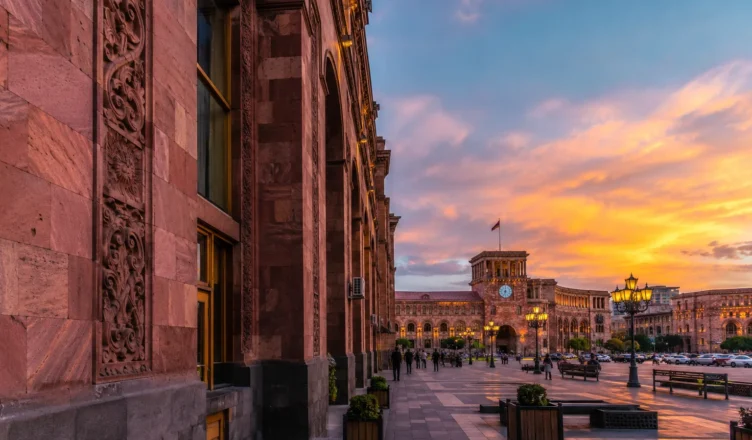
Yerevan is often introduced as the “Pink City,” and it takes only a few minutes in the historic center to understand why. Republic Square, government buildings, apartment blocks and cultural landmarks glow in shades of rose, peach and warm apricot.
But the nickname tells only part of the story.
Look more carefully, and you will discover buildings made from orange, dark red, brown, violet and almost black volcanic stone. These colors are not painted onto the façades. They come from the stone itself, turning central Yerevan into a kind of open-air geological and architectural gallery.
This easy self-guided walk reveals a side of the Armenian capital that many visitors pass without noticing.
Quick route information
Starting point: Republic Square
Main route: Republic Square – Abovyan Street – Charles Aznavour Square – Opera area – Cascade
Optional final stop: Tigran Petrosyan Chess House
Recommended time: About 1.5–2 hours without museum visits
Cost: Free
Best light: Late afternoon and the hour before sunset
Difficulty: Easy, with a gradual uphill section toward the Cascade
Why Does Yerevan Have So Many Stone Colors?
Much of Yerevan’s visual identity comes from tuff, a volcanic stone widely used in Armenian architecture. Pink is its most famous shade, but Armenian tuff can also appear red, orange, brown, gray, black and nearly white. The different colors are connected to the stone’s mineral composition and the geological conditions in which it formed.
Armenia’s official tourism platform notes that tuff is used extensively throughout Yerevan and is the main reason the capital became known as the Pink City. Official descriptions of individual historic buildings also identify façades made from orange, black, dark red and Ani tuff, confirming that the city’s stone palette is much richer than its nickname suggests.
Stop 1: Republic Square — Learn to See More Than Pink
Begin in Republic Square, the architectural heart of central Yerevan.
Instead of immediately photographing the entire square, walk closer to the buildings. From a distance, the façades may appear uniformly pink. Up close, the stone reveals milky, peach, golden and brown undertones. Gray basalt at the lower levels creates a cooler contrast with the warmer upper façades.
The present architectural composition of the square was shaped by Alexander Tamanyan’s plan for Yerevan. Its buildings use polished Armenian pink tuff, light-colored felsite and gray basalt, creating a carefully balanced combination of color and texture.
Observe the façades from several positions. The same stone may appear pale under strong daylight, deeper after rain and almost orange shortly before sunset.
What to notice: differences between individual stone blocks, carved arches, lower basalt sections and the way light changes the façades.
Stop 2: Walk Toward Abovyan Street
Leave Republic Square and continue toward Abovyan Street, one of the most rewarding streets in central Yerevan for anyone interested in older architecture.
The ground floors now contain cafés, restaurants and shops, but the upper levels preserve balconies, carved window frames and stone ornamentation from different periods. Remember to look above the signs and storefronts.
Here, Yerevan’s color palette begins to expand. Some historic buildings are made from finely dressed black Yerevan tuff, while others feature orange stone. Official city heritage descriptions document both black- and orange-tuff buildings along Abovyan Street.
The darker façades feel especially dramatic beside the lighter buildings of the city center. On cloudy days they may look almost charcoal-colored, while direct sunlight reveals subtle brown, red or violet undertones.
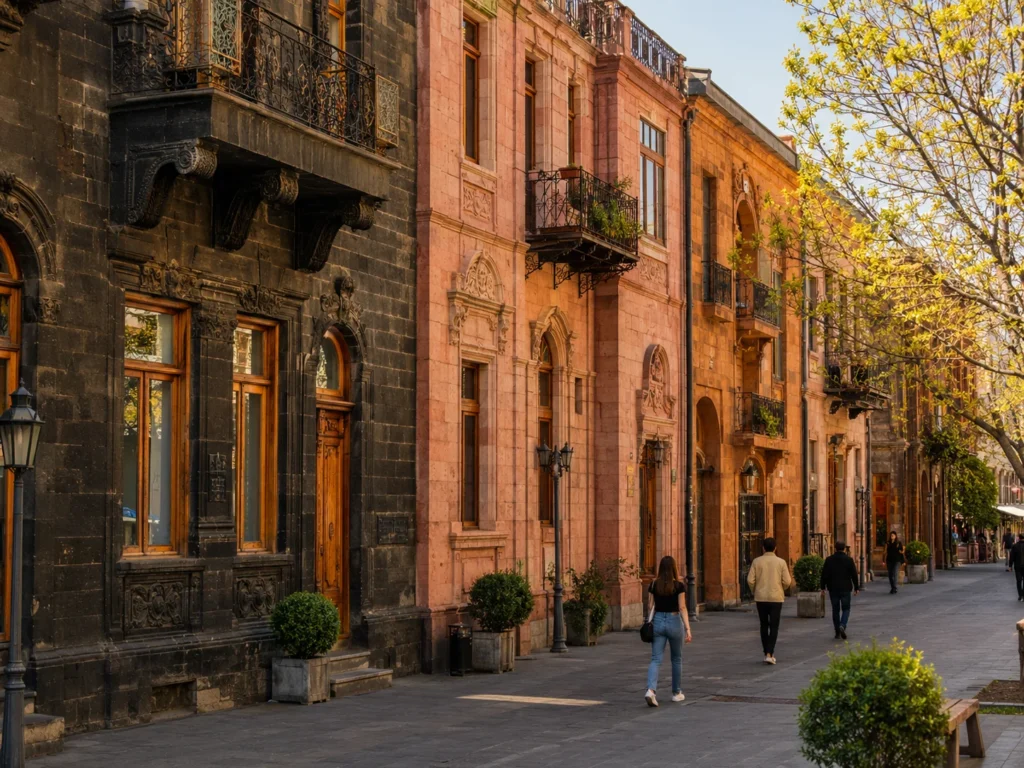
Photography tip: Do not photograph only the entire building. Capture a close view of the stone, a balcony and one decorative window frame. These details communicate the character of old Yerevan better than a wide street photograph alone.
Stop 3: Charles Aznavour Square — Compare Materials and Styles
Continue along Abovyan Street toward Charles Aznavour Square.
The architecture here demonstrates how Yerevan’s builders combined different materials and styles. Tuff, basalt, glass, plaster and reinforced concrete all appear within the square’s architectural environment. This mixture creates a useful comparison between warm volcanic stone and colder modern surfaces.
Pause near Moscow Cinema and turn slowly around the square. Notice how the color of the surrounding buildings changes depending on the direction of the sunlight.
This is also a good place to take a short break before continuing toward the Opera area.
Stop 4: The Opera Area — Stone, Green Space and Open Sky
As you approach the Armenian National Academic Theatre of Opera and Ballet, the streets become wider and the city feels more open.
The lighter stone façades around this part of Yerevan look especially warm beside the green trees and blue sky. Architectural details that seemed heavy on narrow streets appear softer in this more spacious setting.
Walk around the Opera building rather than crossing the area in a straight line. The stone changes character depending on the angle, weather and time of day. A façade that appears pale beige at noon may take on a warmer pink or apricot tone in the evening.
What to notice: the transition from the enclosed atmosphere of Abovyan Street to the open public spaces around the Opera.
Stop 5: The Cascade — End With a Wider View
Continue along the pedestrian axis toward the Cascade.
The Cascade adds another material and visual layer to the walk. Its monumental stairway connects central Yerevan with the higher northern part of the city and offers changing views as you climb.
The official Yerevan municipal description states that the complex contains 572 steps and stretches approximately 450 meters from its base to the upper platform.
From the lower garden, compare the pale stone of the Cascade with the pink, brown and gray buildings surrounding it. Higher up, the city’s individual façades begin to merge into a broad urban landscape.
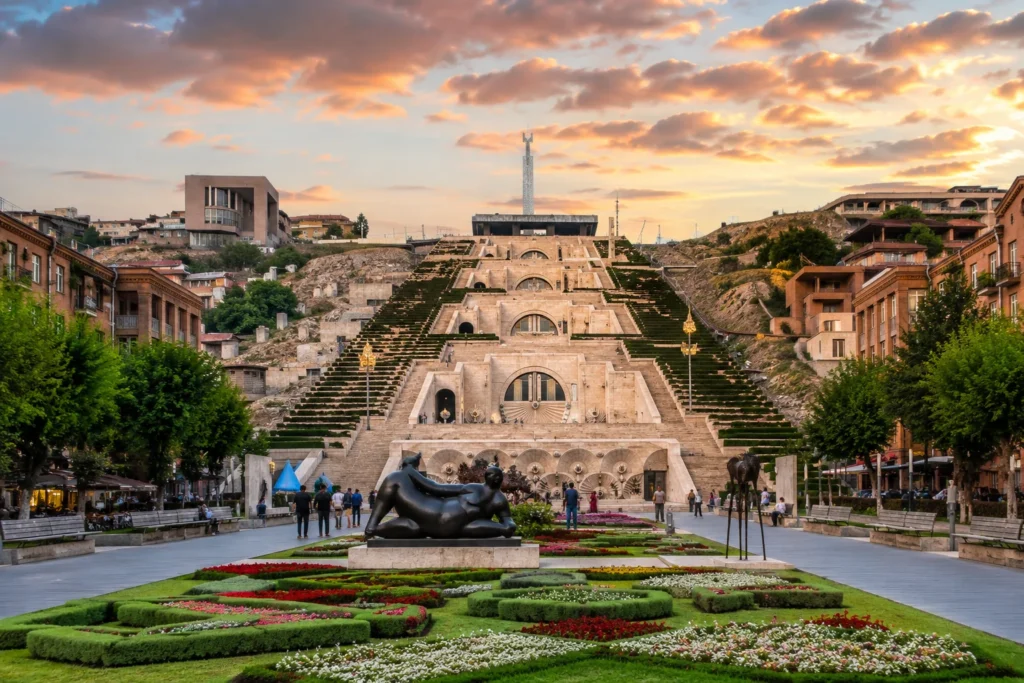
On a clear day, the upper platforms may also offer a view toward Mount Ararat. Even when the mountain is hidden by haze, the elevated view helps reveal how stone architecture shapes the identity of central Yerevan.
Practical note: Visitors who do not wish to climb every outdoor step can enter the Cafesjian Center for the Arts and use the internal escalators during opening hours. Access conditions and exhibition hours should be checked before visiting.
Optional Stop: Tigran Petrosyan Chess House
Travelers who want to see how Armenian stone was used in Soviet modernist architecture can add the Tigran Petrosyan Chess House to the route.
Located at 50a Khanjyan Street in Circular Park, the building has an unusual triangular form often compared to a chess rook. Its façades are faced with finely dressed Ani tuff and decorated with copper chess pieces. The building is considered one of Yerevan’s notable examples of Soviet modernism.
This stop shows that volcanic stone was not used only for traditional or neoclassical façades. Armenian architects also adapted it to bold twentieth-century forms.
When Is the Best Time to Take This Walk?
Late afternoon is usually the most rewarding time because the lower sun brings out the warm tones of the stone and creates deeper shadows around balconies, arches and carvings.
Each season produces a different atmosphere:
Spring: flowering trees soften the dark façades.
Summer: strong sunlight creates clear contrasts between pink, orange and black stone.
Autumn: golden leaves complement red and brown tuff.
Winter: bare trees make architectural details easier to see.
After light rain, the stone often looks darker and more saturated. Comfortable, non-slip shoes are advisable because polished pavements and outdoor steps may be slippery.
How to Photograph Yerevan’s Stone Architecture
Wide photographs are useful, but the most memorable images often come from smaller details. Try capturing:
- two neighboring buildings made from different shades of tuff;
- a carved balcony against a plain stone wall;
- pink stone beside gray basalt;
- the same façade in sunlight and shadow;
- weathered blocks beside newly restored sections;
- reflections of old stone buildings in modern glass.
Avoid photographing only the city’s best-known landmarks. A doorway, balcony or forgotten corner may reveal more about Yerevan’s architectural character than another standard photograph of Republic Square.
Yerevan’s Walls Tell More Than One Story
Calling Yerevan the Pink City is not wrong. It is simply incomplete.
Pink may be the capital’s most recognizable color, but the full story appears in the transitions: from pale rose to apricot, from orange to dark red, and from warm brown to almost black.
These colors connect Armenia’s volcanic landscape with the work of architects, stonecutters and builders. They also show how different generations reshaped the city without completely erasing what came before.
You do not need a museum ticket or an organized excursion to discover this side of Yerevan. You only need comfortable shoes, enough time and the willingness to look closely.
Once you begin noticing the stone, the city will never appear simply pink again.
Read also: The Hidden Yerevan Behind the Front Door: Why the City’s Old Entrances Deserve a Closer Look